
Power infrastructure isn’t just another checkbox on a data center development list—it’s the foundation that determines whether a facility succeeds or fails before construction even begins. While location, connectivity, and physical security all matter, none of these factors hold value if the site lacks sufficient electrical capacity to support thousands of servers running continuously.
The global data center industry consumes approximately 1-2% of worldwide electricity, with individual hyperscale facilities requiring 100+ megawatts of power. This enormous demand makes power availability the single most critical factor in site selection. Developers who overlook electrical infrastructure during the sourcing phase inevitably face project delays, cost overruns, or complete site abandonment.
This article examines why power availability shapes data center development decisions, how to identify sites with adequate electrical infrastructure, and what substation access means for long-term operational viability.
Why Power Capacity Determines Data Center Viability
Data centers operate 24/7/365, creating constant electrical demand that dwarfs most commercial facilities. A medium-sized data center consumes as much electricity as 50,000 homes. This reality transforms power from a utility concern into a strategic asset.
Three power-related factors eliminate potential sites before any other consideration:
Available capacity at the substation level. Local electrical grids weren’t designed for data center loads. Many substations serving commercial or residential areas max out at 20-40 megawatts of total capacity. A single enterprise data center requiring 30 megawatts would consume most of that capacity, leaving nothing for existing customers or future growth.
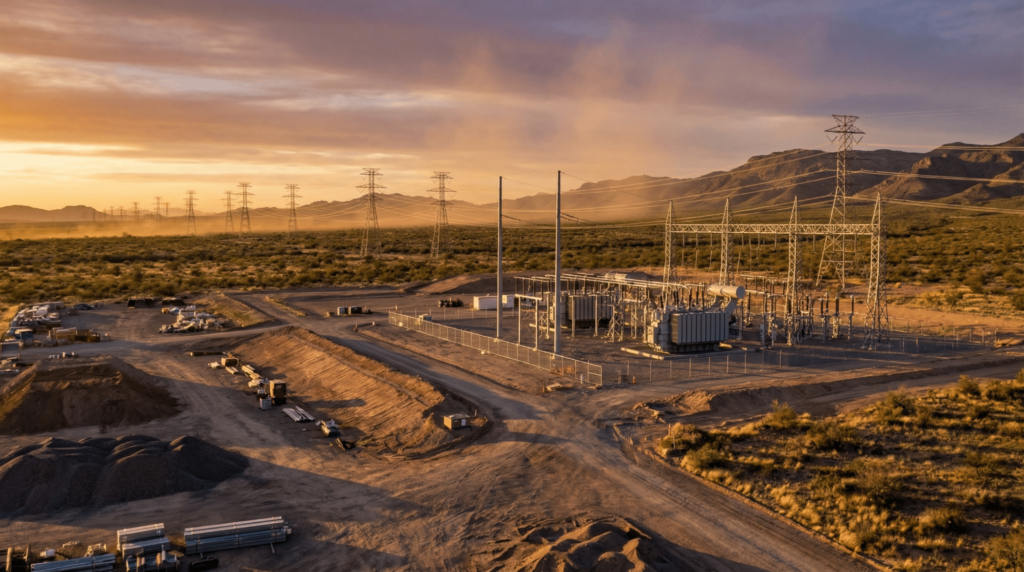
Distance from transmission infrastructure. Extending high-voltage transmission lines costs $1-3 million per mile. Sites located more than five miles from adequate transmission infrastructure face prohibitive connection costs that can exceed land acquisition expenses.
Utility willingness to support expansion. Even when capacity exists, utilities must approve new large loads. Some regions have moratoriums on data center connections due to grid constraints, environmental policies, or community opposition. Understanding powered land for data centers requires evaluating both technical capacity and regulatory environment.
Evaluating Substation Access and Electrical Infrastructure
Substation proximity tells only part of the story. Developers must assess the entire electrical supply chain from generation to final delivery.
Transmission Voltage Levels
Data centers ideally connect to transmission lines operating at 115kV or higher. Lower voltage distribution lines (13kV-69kV) require additional transformation steps, increasing costs and introducing potential failure points. Sites with direct access to 230kV or 345kV transmission infrastructure offer superior reliability and expansion capacity.
Substation Age and Upgrade Potential
A substation built in 1970 may lack the physical space, modern equipment, or capacity to add data center loads. Developers should request substation one-line diagrams and transformer capacity reports. Key questions include:
- When was the substation last upgraded?
- What percentage of transformer capacity is currently utilized?
- Does the utility have capital plans for substation expansion?
- Are there available breaker positions for new connections?
Redundancy and Reliability Metrics
Tier III and Tier IV data centers require dual utility feeds from separate substations, ideally on different transmission paths. This redundancy protects against single points of failure. Evaluate the utility’s System Average Interruption Duration Index (SAIDI) and System Average Interruption Frequency Index (SAIFI) scores. Regions with SAIDI scores below 100 minutes annually demonstrate superior grid reliability.
Power Procurement Strategies for Data Center Development
Securing adequate power involves more than finding available capacity. Developers must navigate utility interconnection processes, negotiate favorable terms, and plan for future expansion.
Interconnection Application Process
The utility interconnection queue determines when power becomes available. In high-demand markets, queue positions stretch 3-5 years into the future. Early interconnection applications—filed during site due diligence—preserve queue position and lock in capacity allocations.
The interconnection study reveals actual costs and timelines. These studies typically proceed in phases: feasibility study ($10,000-$50,000), system impact study ($50,000-$200,000), and facilities study ($100,000-$500,000). Each phase provides increasing detail about required infrastructure upgrades.
Power Purchase Agreements and Rate Structures
Industrial electricity rates vary dramatically by region, from $0.03/kWh in the Pacific Northwest to $0.15/kWh in California. These differences compound over time. A 50MW facility operating at 80% utilization consumes 350,000 MWh annually. A $0.05/kWh rate difference equals $17.5 million in annual operating costs.
Understanding comprehensive data center site requirements includes evaluating not just availability but also long-term rate stability and renewable energy options.
Geographic Considerations for Power-Rich Locations
Certain regions offer superior power infrastructure due to generation proximity, historical industrial development, or utility-friendly policies.
Primary and Secondary Markets
Northern Virginia, Phoenix, Dallas, and Chicago dominate data center development partly because utilities in these regions actively court large loads. These markets feature:
- Multiple substations with 100+ MW available capacity
- Established interconnection procedures
- Competitive electricity rates
- Utility staff experienced with data center requirements
Secondary markets like Columbus, Reno, and Des Moines increasingly attract development as primary markets reach capacity constraints.
Renewable Energy Access
Corporate sustainability commitments drive demand for renewable energy. Sites near wind farms, solar installations, or hydroelectric facilities offer direct renewable power access. Some developers prioritize locations where utilities offer 100% renewable energy tariffs or where direct power purchase agreements with generators are feasible.
Infrastructure Development and Timeline Management
Even ideal sites require 18-36 months for utility infrastructure construction. Developers must sequence power delivery with building construction to avoid costly delays.
Substation upgrades typically require 12-18 months after utility approval. Transmission line extensions add 6-12 months per mile. These timelines assume no permitting delays, supply chain disruptions, or community opposition. Prudent developers add 20-30% buffer time to utility-provided estimates.
Temporary power solutions—such as mobile substations or generator farms—can bridge gaps but add $2-5 million in capital costs for a 20MW facility. These solutions work for phased developments where initial power supports early operations while permanent infrastructure completes.
Frequently Asked Questions
What power capacity does a typical data center require?
Enterprise data centers typically require 5-30 megawatts, while hyperscale facilities need 100-300 megawatts or more. Colocation facilities generally operate in the 10-50 megawatt range. Power requirements depend on server density, cooling systems, and redundancy levels. N+1 or 2N redundancy configurations effectively double the required utility capacity.
How far can a data center be from a substation?
Most developers target sites within 1-3 miles of adequate substations. Beyond three miles, transmission line extension costs become prohibitive unless the facility requires exceptional power loads that justify the investment. Some hyperscale developments have successfully extended lines 5-10 miles when no closer alternatives exist.
What happens if power capacity is insufficient?
Insufficient power capacity forces developers to either downsize the facility, wait for utility infrastructure upgrades, or abandon the site entirely. Retrofitting power infrastructure after building construction proves extremely expensive and disruptive. This scenario explains why power availability drives initial site selection rather than being addressed later in the development process.
Can renewable energy fully power a data center?
Yes, but implementation varies. Some data centers achieve 100% renewable power through direct connections to wind or solar farms combined with battery storage. Others purchase renewable energy credits while drawing from the general grid. True 24/7 renewable operation requires either on-site generation with storage or locations with abundant hydroelectric power.
How do utilities prioritize data center power requests?
Utilities evaluate requests based on interconnection queue position, technical feasibility, required infrastructure investment, and alignment with grid planning objectives. Developers who file early applications, demonstrate financial capability, and propose facilities in areas with available capacity receive priority. Some utilities maintain specific data center development programs with dedicated staff and streamlined processes.
What are typical interconnection costs for data centers?
Interconnection costs range from $5 million to $50 million depending on distance from infrastructure, required voltage transformation, and substation upgrades. A facility connecting to an existing substation with available capacity might spend $5-10 million. Sites requiring new transmission lines or substation construction can exceed $30 million. These costs typically fall on the developer rather than the utility.
Conclusion
Power availability transcends technical specifications to become the defining constraint in data center site selection. Developers who prioritize electrical infrastructure access, substation capacity, and utility relationships position their projects for success. Those who treat power as a secondary concern face delays, budget overruns, and competitive disadvantages that no amount of architectural innovation can overcome.
The data center industry’s explosive growth continues straining electrical grids worldwide. Forward-thinking developers now evaluate power availability before location, connectivity, or any other site characteristic. As renewable energy mandates and grid capacity constraints intensify, the strategic advantage belongs to those who secure powered land with robust electrical infrastructure and substation access today.