

Choosing a solar generator for home backup is a critical decision that balances preparedness with practicality. An undersized unit leaves you in the dark during an outage, while an oversized system represents a significant, unnecessary investment. The key to maximizing efficiency, reliability, and value lies in precise sizing. This process isn’t about guesswork; it’s a systematic evaluation of your energy needs, appliance demands, and desired runtime.
Properly sizing your system ensures it can handle your essential loads without strain, extends the lifespan of the battery, and allows you to plan an effective solar recharging strategy. This guide will walk you through the essential steps, from conducting a home energy audit to understanding the critical difference between wattage and watt-hours. By the end, you’ll have a clear framework for selecting a system that provides true peace of mind and operational efficiency.
Conduct a Home Energy Audit: Know Your Essentials
The first and most crucial step is identifying what you need to power during an outage. Not everything in your home is critical. Create a list of essential appliances and devices, focusing on those related to safety, health, food preservation, and basic communication.
Identify Critical Loads
Critical loads vary by household but typically include:
- Refrigeration: A modern fridge/freezer combo uses 150-250 watts when running.
- Lighting: LED bulbs are highly efficient, using only 5-15 watts each.
- Communication & Devices: Modems/routers (10-20W), laptops (50-100W), and phone chargers.
- Medical Equipment: CPAP machines (30-60W), oxygen concentrators, or refrigerated medications are non-negotiable and must be prioritized.
- Well Pumps or Sump Pumps: These have high starting surges (often 2-3x their running wattage) and are crucial for water access or flood prevention.
- Heating/Cooling: A small space heater (1500W) or a fan (50-100W) can be essential for climate control.
Write down each item, its running watts, and—critically—its starting surge wattage if it has a motor (like a pump or fridge compressor). This list forms the foundation of your sizing calculation.
Understand Power (Watts) vs. Capacity (Watt-Hours)
This is the most common point of confusion. Power (Watts) is the rate of energy consumption—how much electricity an appliance draws at any given moment. Capacity (Watt-Hours or Wh) is the total amount of energy storage—how long the generator can supply power.
A generator’s inverter rating (e.g., 2000W) tells you the maximum load it can power at once. Your appliance list’s total running watts must be below this limit. Its battery capacity (e.g., 2048Wh) tells you how much energy is in the tank. This determines runtime.
Runtime Formula: (Battery Capacity in Wh) / (Total Running Watts of Appliances) = Approximate Hours of Run Time.
Example: Running a 200W fridge and 50W of lights (250W total) on a 2048Wh battery gives you roughly 8 hours of runtime. This is a simplification, as inverters have efficiency losses (typically 10-15%), but it provides a reliable estimate. For robust home backup, many homeowners start their search by exploring capable solar generators for home backup that offer both high inverter outputs and substantial battery capacities.
Calculate Your Total Daily Energy Needs
With your list of critical loads, estimate your total daily watt-hour consumption. This tells you how large your battery needs to be.
- Note Running Watts: For each appliance, find its running wattage (on the label or manual).
- Estimate Daily Usage: How many hours per day will you run each item during an outage? A fridge cycles on and off; estimate 8-12 hours of actual compressor run time.
- Calculate: (Running Watts) x (Hours of Use) = Watt-Hours per day for that appliance.
Sample Calculation:
- Refrigerator: 200W x 10 hours = 2,000 Wh
- 10 LED Lights: 100W total x 5 hours = 500 Wh
- Modem & Laptop: 70W total x 8 hours = 560 Wh
- Total Daily Need: 3,060 Watt-Hours
This 3,060Wh is the energy your battery must supply each day. To avoid draining the battery to zero (which harms its lifespan), you should aim for a battery capacity 20-30% larger than your calculated need—so roughly 4,000Wh in this case.
Account for Inverter Limits and Surge Power
Your generator’s inverter must handle the combined wattage of appliances running simultaneously. Add up the running watts of all devices you might use at the same time.
More importantly, you must account for surge or starting power. Motors in compressors, pumps, and power tools can require 2 to 5 times their running wattage for a few seconds to start. A 500W well pump might need a 1,500W surge. Your solar generator’s inverter must have a surge rating that exceeds the highest surge in your system. High-quality pure sine wave inverters, like those found in premium models, are essential for safely powering sensitive electronics and handling demanding motor starts.
Sizing Your Solar Array for Recharging
A solar generator is only sustainable if you can recharge it. Sizing your solar panels correctly is vital for multi-day outages or off-grid use.
- Start with Your Daily Energy Need: From our example, 3,060 Wh.
- Adjust for Sunlight: Solar panel output is rated in ideal lab conditions. In the real world, account for weather, less-than-optimal panel angles, and seasonal variations. A common rule is to use 4-5 “peak sun hours” as a conservative daily average for calculation.
- Calculate Panel Wattage Needed: (Daily Watt-Hour Need) / (Peak Sun Hours) = Minimum Solar Wattage.
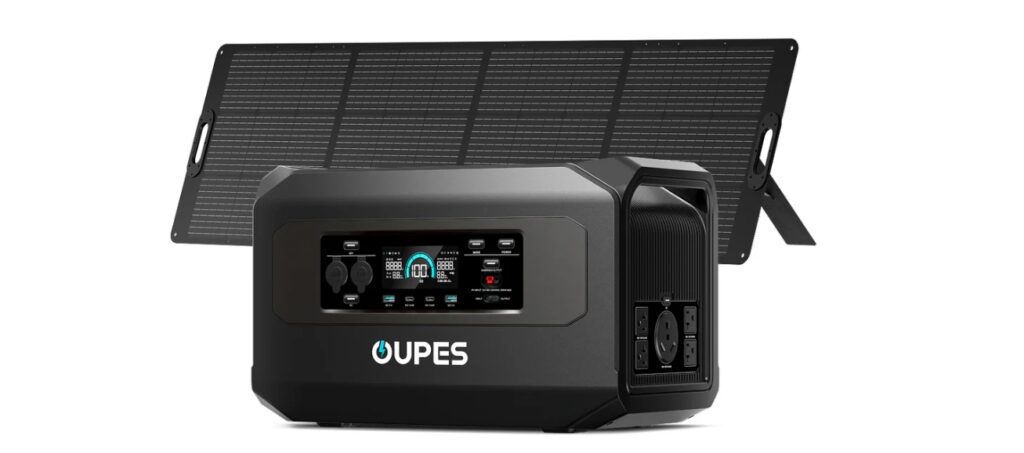
This means you’d need approximately 800W of solar panels to fully recharge your system’s battery from empty in one average sunny day. Always check the maximum solar input voltage and wattage your specific generator can accept. For a system designed to meet these substantial energy and recharging demands, a unit like the OUPES Mega 2 Pro power station with its 2500W inverter, 2048Wh capacity, and high solar input compatibility serves as a relevant benchmark for a robust home backup setup.
Putting It All Together: A Sizing Checklist
Before making a purchase, run through this final checklist:
- Critical Load List Complete: All essential appliances with running and surge watts documented.
- Total Daily Watt-Hours Calculated: Target battery capacity is 20-30% higher than this number.
- Simultaneous Load Check: Combined running watts are under the inverter’s continuous rating.
- Surge Capacity Verified: Inverter surge rating exceeds the largest appliance starting surge.
- Solar Recharge Plan: Solar panel wattage calculated based on local sun hours and generator input limits.
- Expandability Considered: Does the system allow for adding extra battery modules or solar panels later?
Frequently Asked Questions
What’s the difference between a solar generator and a gas generator?
A solar generator is a battery-powered inverter system that stores energy from solar panels (or a wall outlet) for silent, fume-free, low-maintenance backup power. A gas generator burns fuel to create electricity on-demand, offering higher continuous power but requiring fuel storage, ventilation, and regular maintenance. Solar generators are ideal for cleaner, quieter operation for essential loads.
Can I run my central air conditioner on a solar generator?
It is generally impractical. Central AC units have very high starting surges (often 3,000-5,000W or more) and running loads (1,500-3,500W). This would require an extremely large and expensive solar generator system. For backup cooling, focus on efficient window units or ductless mini-splits, and ensure the generator’s surge rating is sufficient.
How long will a solar generator last during an outage?
Runtime depends entirely on the battery capacity (Wh) and what you’re powering. A 2,000Wh unit could run a 50W fridge for about 40 hours, or a 1,500W space heater for just over an hour. The key is to calculate based on your specific essential loads, as outlined in the energy audit section.
Do I need an electrician to install a solar generator for backup?
For basic portable use, plugging appliances directly into the unit, no installation is needed. For integrating with your home’s circuit panel to power wall outlets—known as a critical loads panel—you must hire a licensed electrician to ensure a safe, code-compliant installation, including a proper transfer switch to protect utility workers.
How do I maintain my solar generator’s battery?
For Lithium Iron Phosphate (LiFePO4) batteries, common in modern units, maintenance is minimal. Avoid storing the unit at full or empty charge for long periods; 50-80% is ideal for storage. Keep it in a cool, dry place. Follow the manufacturer’s specific guidelines for optimal battery health and longevity.
Conclusion
Properly sizing a solar generator for home backup is a methodical process that pays dividends in reliability and cost-effectiveness. It begins with a clear-eyed assessment of your true energy needs, separating essential loads from conveniences. Understanding the fundamental difference between power (watts) and energy (watt-hours) allows you to match a system’s capabilities to both your peak demands and required runtime.
Ultimately, an accurately sized system performs efficiently, avoids unnecessary strain on components, and provides the security you intend. By taking the time to audit, calculate, and plan—including for solar recharging—you invest in a solution that is not just a piece of equipment, but a tailored foundation for resilience. This strategic approach ensures that when the grid goes down, your power stays on, precisely as needed.